
by Marco Consolo –
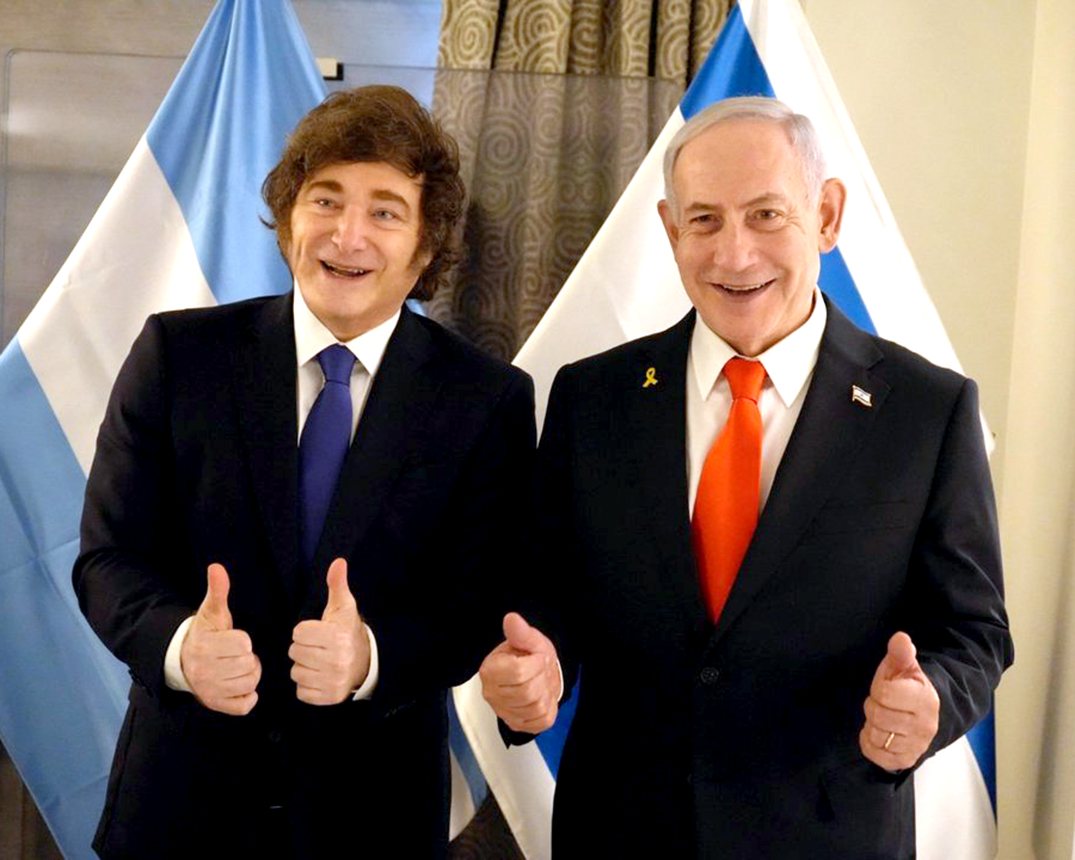
On the map of Israel’s presence in Latin America, the emblematic case of Argentina could not be overlooked, whereas its president, Javier Milei, immediately sided with Zionism.
The “most Zionist president in the world” (according to himself) is a regular visitor to Jerusalem and a close ally of Netanyahu, as well as of Donald Trump. On April 19, during his third trip in just a few months (and in the midst of the genocide in occupied Palestine), Milei and Netanyahu signed the so-called Isaac Agreements in Jerusalem. These agreements follow in the footsteps of the Abraham Accords, signed in 2020 by Israel and several Arab countries, with Trump’s support during his first term. The governments of the two countries signed separate memoranda of understanding in various areas. These include the opening of a $150 million line of credit to support Israeli businesses in Argentina, an agreement on technology and artificial intelligence, and the launch of direct flights between Buenos Aires and Tel Aviv starting in November.
According to a statement from the Argentine Ministry of Foreign Affairs, “The Isaac Agreements constitute a new strategic framework aimed at strengthening cooperation between Argentina, Israel and like-minded partners in the Western Hemisphere, the descendants of Isaac and nations with a Judeo-Christian tradition, in defence of freedom and democracy and in the fight against terrorism, anti-Semitism and drug trafficking” [i]. In other words, as well as strengthening “diplomatic, commercial, cultural and security” ties, the agreements therefore also seek to involve other Latin American countries “in defence of the Judeo-Christian values of the West”. A refrain we have been familiar with in Europe for some time.
A few days before the signing of the Isacco Agreements, as a business card, on 2 April 2026 the Argentine government designated both the Islamic Revolutionary Guard Corps of Iran and the Quds Force, one of its operational arms, as terrorist organisations. Following the ensuing diplomatic skirmish, Buenos Aires also expelled Iran’s counsellor and chargé d’affaires, Mohsen Soltani Tehrani [ii].
In Jerusalem, Milei was also awarded the Presidential Medal of Honour, Israel’s highest civilian honour, bestowed upon those who make an ‘outstanding contribution to the State of Israel or to humanity’ [iii].
Argentina for sale to foreigners
Since the signing of the Isacco Agreements, the Israeli presence in the country has grown stronger and concerns are mounting over the sale of land to parties with varying degrees of connection to Zionism.
The foreign names of some of the current owners of Argentine land are well known: “the Benetton Group owns 920,000 hectares in Patagonia. Joe Lewis owns 38,000 hectares in Río Negro, with access to Lake Escondido, which is closed to the public. Donald Trump, Peter Thiel, Paul Tudor Jones and Eduardo Elsztain are interested in acquiring ever-increasing shares of the territory.”
Against this backdrop, the government’s recent draft bill on the sale of land to foreigners has caused considerable concern. According to the Land Observatory at the University of Buenos Aires (UBA), some 13.2 million hectares (132,000 square kilometres) are currently in foreign hands – an area comparable to that of Greece. This represents 5 per cent of the country’s total land area. According to figures from the Argentine Ministry of Justice, Javier Milei’s government has issued 111 authorisation certificates for the purchase of rural land by foreigners. In 2024, there were 35; in 2025 ‘only’ 29; whilst in the first few months of 2026, the figure has already reached 47 [iv]. The current law, enacted in 2011, sets a limit of 15 per cent on the sale of land to foreigners. Taking advantage of the public’s distraction during the World Cup, Milei’s draft ‘law on the inviolability of private property’ sought to raise this limit from 15 per cent to 25 per cent. This neo-colonial assault bore the ‘signature and stamp’ of Federico Sturzenegger, ‘Minister for Deregulation and State Transformation’, and had the explicit aim of removing limits and controls on the acquisition of property by foreigners. As if that were not enough, it sought to remove obstacles to evictions and protective mechanisms for communities and small-scale producers, as well as to relax the restrictions on the use of burnt areas, as laid down in the law.
However, despite intense pressure on MPs, on 16 August, Javier Milei’s government suffered its third defeat in its attempt to tamper with the existing law. For the time being, the bill has been rejected, partly thanks to a massive popular mobilisation that thwarted the government’s plans [v].
During the parliamentary debate, a senator from the province of La Rioja, Fernando Rejal, recalled a sensational case from 2008. That year, at a Banco Nación auction in Buenos Aires, an American rabbi, Iaim Yosef Libersohn, had purchased a mere 200,000 hectares in the province of La Rioja for 650,000 dollars. Unfortunately, the land purchased includes an entire village (Valle Hermosa) with its inhabitants, church, school, etc., as well as the most important water reservoir in La Rioja, Argentina’s driest province [vi]. Thanks to a television exposé, the case had sparked national outrage. In July 2010, the National Ministry of the Interior, then headed by the Kirchnerist Florencio Randazzo, intervened to suspend the transaction, launched an investigation into the procedure and reported ‘irregularities’ in the paperwork and the sale contracts. This led Libersohn to file a complaint with the Federal Court in New York, which ultimately came to nothing.
Fires and changes in land use
In Argentina, current legislation (Law No. 26,815) prohibits any change in the use or designation of native forests, protected areas and wetlands affected by fires – whether arson or accidental – for a period of 60 years. This 60-year protection also imposes restrictions on the division, parcelling, subdivision and property development of these areas. In the Milei government’s draft bill on the ‘inviolability of private property’, these safeguards were removed, effectively eliminating the restrictions.
In recent years, and on several occasions, ‘hiking tourists’ have turned up in southern Argentina, as has also been the case in Chile [vii]. As was the case with Italy, many of them are soldiers or reservists from the IDF who come to ‘unwind’ at the end of their military service and following the massacres on Palestinian soil. In several well-documented cases [viii], the presence of these ‘tourists’ coincides, as if by chance, with terrible fires that have ravaged large swathes of land [ix]. Between late 2025 and early 2026, the fires devastated more than 230,000 hectares in Chubut, La Pampa, Río Negro, Neuquén and Santa Cruz.
Again, quite by chance, rumours are rife about property developments linked to Israeli companies, despite Zionist sources vehemently denying them
The Malvinas and the oil
The Argentine Coalition for the Malvinas Islands, together with the country’s BDS campaign, has denounced the presence on the islands of the Israeli company Navitas Petroleum, through its British subsidiary, Navitas Petroleum Development and Production, in an area that is the subject of a long-standing sovereignty dispute between Argentina and the United Kingdom [x].
Navitas Petroleum (together with Rockhopper Exploration) has announced a multi-million investment to develop the first phase of the Sea Lion oil field [xi], discovered in 2010 some 220 kilometres north of the Malvinas Islands. With an initial investment of US$1.8 billion, the development plan aims to extract over 170 million barrels of oil from the estimated reserves in the initial phase, with a planned expansion that could double that figure. The long-term potential value of the fields could exceed US$10 billion.
Navitas Petroleum is headed by Gideon Tadmor, a pioneer in the Israeli energy sector, whilst the chief executive is Amit Kornhauser, former chief financial officer of Navitas and Delek Energy. Argentine nationals are conspicuous by their absence, both on the board of directors and amongst the major institutional shareholders.
A few days ago, President Milei, in a surprise populist electoral move designed to pander to Argentine nationalism, announced sanctions against companies involved in hydrocarbon extraction in the Malvinas Islands. In response, and partly to reassure its shareholders, Navitas stated in a press release that: “The company considers that recent events will have no material effect” [xii]. In other words, for Navitas Petroleum, there will be no changes, either to the extraction project or to the planned timetable.
Water (Mekorot) and lithium (XtraLit)
Israeli companies in Latin America are not limited to the arms and security sectors. There is another significant presence, less ostentatious but equally strategic: Mekorot, the state-owned company that manages Israel’s water resources. A name that, in UN reports, has appeared for over thirty years alongside a weighty term: ‘water apartheid’. The practice is well known — depriving Palestinians of water to guarantee it for Israeli settlers — yet Mekorot continues to expand abroad as if nothing were amiss.
Mekorot has put down deep roots in Argentina: 12 out of 23 provinces have signed consultancy agreements and water management plans with the company, alongside the giant AySA (Agua y Saneamientos Argentinos) [xiii], the company that controls Buenos Aires’ water and sanitation services. All this took place without a public tender, without consultation, and without transparency. A direct award that sidelined universities, scientific institutes and local professionals – precisely those who are experiencing the water crisis and its social and environmental consequences first-hand.
And that’s not all. In the north of the country, where lithium is mined, President Javier Milei has just struck a deal with the Israeli company XtraLit [xiv]. It’s a perfect fit: Mekorot controls the water, XtraLit consumes it. As is well known, lithium mining guzzles millions of litres of water, depriving communities that are already living in conditions of water scarcity. The result is a stark paradox: whilst the government promises development and modernisation, it is handing over the key to the country’s most fragile resource to a foreign company.
Mass surveillance and artificial intelligence
Whilst bombarding Gaza, Israel is offering its ‘services’ enhanced by artificial intelligence, including guided missiles that enable targets to be identified with an ‘acceptable’ level of ‘collateral damage’.
In Argentina, a ‘cooperation agreement on public security and home affairs’ was signed with Israel in September 2017 [xv], whilst police forces from several provinces (including Buenos Aires, Tucumán, Salta, San Juan and Santa Fe) undertook training trips to Israel. The Zionist entity has also developed surveillance software used in Latin America to violate human rights. One such example is the Pegasus software, developed by the Israeli company NSO Group, which allows the microphone and camera of mobile phones to be controlled. In Argentina, the software used for spying in two high-profile cases (those involving the families of Santiago Maldonado and Jones Huala) is also Israeli, in this instance developed by the company Voyager Labs.
Peter Thiel and Palantir in Argentina
Following Honduras and the attempt to establish the ‘Prospera city-state’ there [xvi], Argentina is now in the sights of Peter Thiel [xvii]. Thiel (a German entrepreneur and politician who has become a naturalised citizen of the United States and New Zealand) was a co-founder of PayPal and one of Facebook’s earliest investors, but his business interests extend far beyond the financial world. He is also a co-founder of Palantir Technologies, a company specialising in big data analytics, artificial intelligence and platforms used by military organisations, intelligence services and security agencies in various countries. His company is among the most influential in the US military-industrial-technological complex, and boasts contracts with the US Department of Defence, intelligence agencies and certain Western armed forces.
The entrepreneur has had links with Argentina since at least 2017, when Mauricio Macri was in power and his company sought to win the contract to digitise the archives relating to the AMIA case. Palantir has had an official presence there since 2022. At the time, Thiel secured the support of Santiago Caputo (Milei’s political and financial adviser and one of the architects of his election victory) [xviii].
Among Thiel’s earliest contacts was the then Senator Patricia Bullrich, a politician for all seasons. With a distant past in the Peronist Youth (JP), she later became a ‘strong woman’ in Mauricio Macri’s government, where she served as Minister for Labour and Minister for Security. She subsequently stood as Macri’s presidential candidate, before switching sides lock, stock and barrel to join Milei, who appointed her Minister for Security once again; she is now her party’s (La Libertad Avanza) leader in the Senate.
On 12 April, Peter Thiel stepped off his private jet in Buenos Aires, like a modern-day 21st-century conquistador. At his side was his husband, Matt Danzeisen, former vice-chairman of BlackRock. Thiel, a former associate of Jeffrey Epstein [xix], has bought a ‘modest’ house worth about $12 million in the upmarket Palermo Chico neighbourhood. But the real game isn’t in Buenos Aires: it’s in Patagonia.
His interest in southern Argentina has surged following Milei’s green light for the reform of the law on glaciers, which was approved on 9 April. This reform reduces the protection afforded to glaciers and opens the door to lithium and copper mining in the country’s most sensitive areas [xx], effectively unlocking Argentina’s natural treasure trove.
And this is where Thiel comes in. Because artificial intelligence data centres — which are fuelling the new global race for digital power — are hungry for two things: energy and water. Patagonia has both in abundance.
In the energy sector, his Thiel Macro fund has just acquired around 1 per cent of the shares in Vista Energy, owned by the Argentine entrepreneur Miguel Galuccio, one of the leading oil operators in the Vaca Muerta area [xxi].
In other words, whilst Milei is dismantling environmental protections, one of the most influential billionaires and the ‘dark soul’ of Silicon Valley is preparing to get his hands on strategic land rich in water and lithium.
In Argentina, the frontier of AI is a real territory, made up of melting glaciers, resilient communities and global investors sniffing out a bargain.
According to reports in Il Fatto quotidiano, during that visit Thiel met with Ministers Federico Sturzenegger (responsible for state deregulation) and Pablo Quirno (Foreign Affairs). The agenda also included a meeting with Milei, who had just returned from Israel following the signing of the Isacco Agreements, which strengthen intelligence cooperation between Tel Aviv and Buenos Aires. The two discussed the services offered by Palantir in terms of data reorganisation and cross-referencing, with particular emphasis on ‘preventive intelligence’ and network-based surveillance of citizens, involving the ‘automatic’ identification of potential threats through the use of AI. This was a prime opportunity, given that in 2025 Milei reformed the Argentine secret services and established the Central Cyberintelligence Agency.
But not everyone is reassured by the similarities between Milei and Thiel. “Palantir doesn’t knock on governments’ doors to offer a tool; it presents itself with a complete worldview,” claims Ezequiel Tosco, Secretary of the Argentine Association of IT Workers (AGC), who draws attention to the ‘Manifesto of the Technological Republic’ recently launched by Alex Karp, the company’s chief executive. “They want to impose a new architecture of power, present a list of enemies and oppose any sort of public debate”, add professionals in the sector. “This company is not merely a technology provider. It has published an explicit manifesto: techno-fascism, supremacism, quasi-racial hierarchies and mass surveillance as a business model. Its founders, Thiel and Karp, label anyone who calls for ethics in AI as the ‘Antichrist’ and claim that democracy is naïve” [xxii]. In short, Karp advocates for the global supremacy of the West through the aggressive use of AI and integration between Silicon Valley and the Pentagon.
Speaking of the Pentagon, Palantir is also in the spotlight for the use of its own software in the US-led bombing of the Shajareh Tayyebeh school in Minab, southern Iran, on 28 February 2026. According to UNICEF, the attack claimed the lives of at least 168 people, most of whom were girls aged between 7 and 12.
As well as Argentina, Thiel already has a presence in Ecuador, where he launched Palantir Foundry, a data analytics platform providing services to the customs authorities and the National Telecommunications Corporation.
In May 2026, Thiel made a low-key visit to Chile, where he met with the current Pinochetist president, José Antonio Kast, and with José Piñera, Minister of Labour and Social Security (1978–80) under Augusto Pinochet’s dictatorship and the architect of the pension system’s privatisation.
(To be continued…)
[i] https://www.cancilleria.gob.ar/es/actualidad/noticias/argentina-e-israel-lanzan-los-acuerdos-de-isaac-para-fortalecer-la-cooperacion
[ii] https://www.dw.com/es/argentina-expulsa-al-encargado-de-negocios-de-ir%C3%A1n/a-76647758
[iii] https://www.trtespanol.com/article/0a2742652442
[iv] https://www.telesurtv.net/golpe-milei-retira-venta-tierra-extranjeros/
[v] https://comunicasul.org/projeto-de-milei-para-vender-terras-a-estrangeiros-e-barrado-argentina-nao-esta-a-venda/
[vi] https://www.hcdn.gob.ar/comisiones/permanentes/csinterior/proyecto.html?exp=5589-D-2010
[vii] https://www.instagram.com/p/DURgj2ZDkd9/
[viii] https://www.youtube.com/watch?v=3FMUSDrQzks
[ix] https://ahoracalafate.com.ar/contenido/37169/indignacion-total-en-pleno-incendio-sorprenden-a-turistas-a-extranjeros-haciendo
[x] https://www.telesurtv.net/cuestionan-titular-secretaria-malvinas-vinculos-londres/
[xi] https://batimes.com.ar/news/economy/diplomatic-tensions-over-malvinas-oil.phtml
[xii] https://www.bloomberglinea.com/latinoamerica/argentina/milei-anuncio-sanciones-a-petroleras-en-malvinas-y-caen-las-acciones-que-dijeron-sobre-el-futuro-de-sea-lion/
[xiii] https://www.anred.org/el-mapa-de-mekorot-en-argentina/
[xiv] https://xtralit.com/blog/2af23c65-f2ea-471d-b30c-5a462fa5b747#start
[xv] https://www.boletinoficial.gob.ar/pdf/aviso/primera/187706/20180705
[xvi] https://marcoconsolo.altervista.org/si-scrive-colombia-si-legge-israele-e-honduras/
[xvii] https://www.nytimes.com/2026/05/28/world/americas/peter-thiel-argentina.html
[xviii] https://www.lanacion.com.ar/politica/quien-es-santiago-caputo-el-arquitecto-de-la-victoria-de-javier-milei-nid20112023/
[xix] https://www.ilfattoquotidiano.it/in-edicola/articoli/2026/02/06/i-legami-tra-epstein-e-peter-thiel-il-tecno-oligarca-di-trump/8281938/
[xx] https://www.ilfattoquotidiano.it/2026/02/13/milei-riforma-ghiacciai-argentina-estrazione-notizie/8288408/
[xxi] https://chequeado.com/el-explicador/peter-thiel-en-argentina-5-datos-sobre-sus-vinculos-con-el-pais/
[xxii] https://x.com/EzequielTosco/status/2047346130850025705?ref_src=twsrc%5Etfw%7Ctwcamp%5Etweetembed%7Ctwterm%5E2047346130850025705%7Ctwgr%5Ecf89625883b594a948295c5d9d5cfafc1e13f119%7Ctwcon%5Es1_&ref_url=https%3A%2F%2Finformaticos.ar%2Fpalantir-una-amenaza-para-la-democracia%2F