
By Marco Consolo –
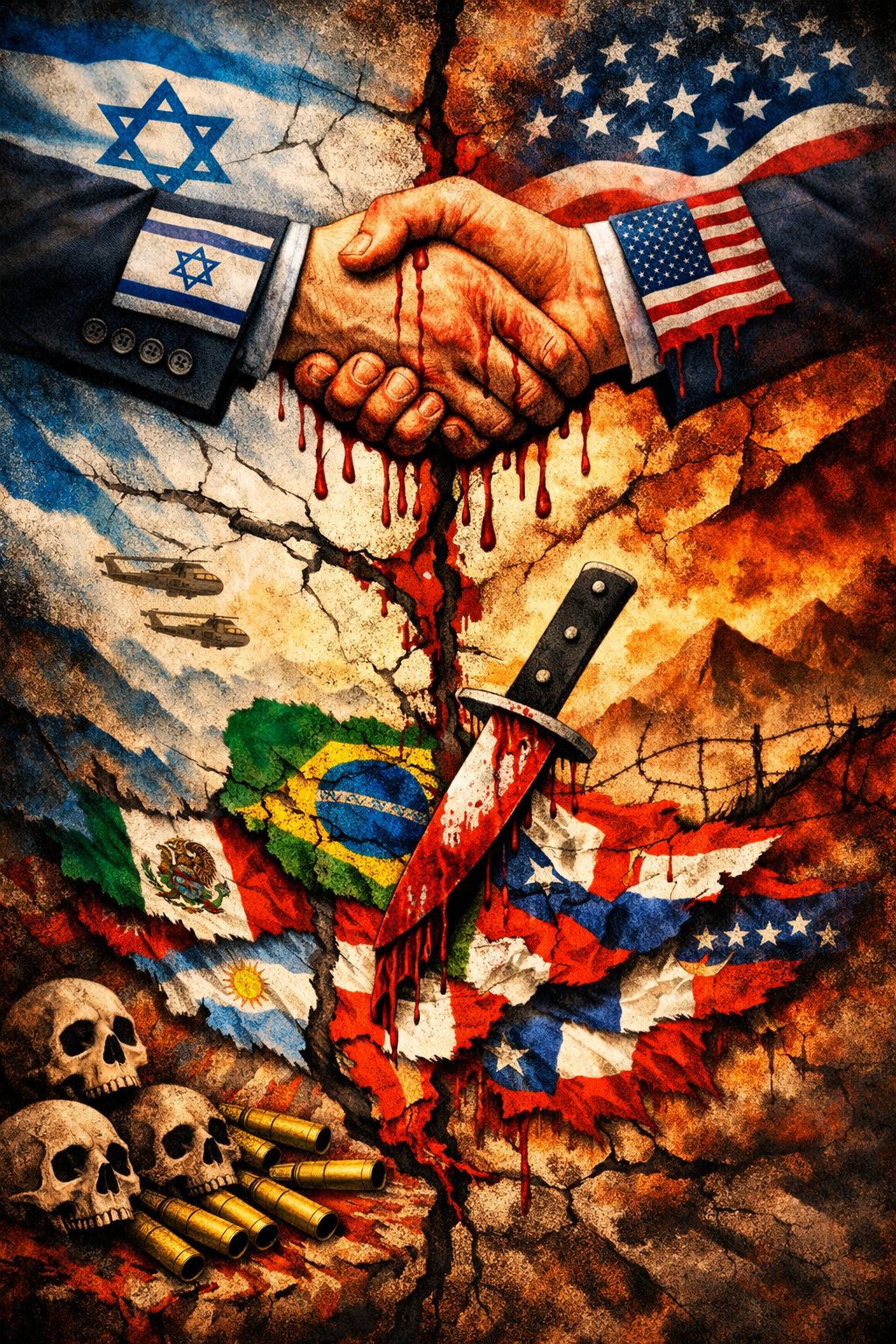
Perhaps not everyone is aware that, in the recent past, Israel supplied weapons, intelligence and training to fascist civil-military dictatorships in Latin America? And that, at present, Israel is increasingly active on the Latin American continent? The Zionist dream of a ‘Greater Israel’ is not confined to the Middle East but also extends to Latin America.
This paper, divided into two parts, examines the dangerous relations between Israel and Latin America, both in the recent past and at present. It is based on various studies carried out by the Latin American BDS movement, on hundreds of news reports, and on the author’s first-hand contacts met during almost 40 years of visiting and living in Latin America and the Caribbean.
The ‘creation’ of Israel and Latin America
Diplomatic relations between Israel and Latin America began immediately after the creation of Israel in 1948.
In 1947, during the early United Nations debates on Palestine, the liberal governments of Latin America were generally in favour of the creation of a Jewish state in Palestinian territory, whilst, conversely, the conservative Catholic governments were less receptive. From the outset, Uruguay, Guatemala and Peru adopted a markedly pro-Zionist stance within the United Nations Special Committee on Palestine (UNSCOP), a commission of inquiry established in 1947 to investigate the causes of the conflict in Palestine, propose a solution for its future governance and draft the partition plan. Under pressure from the United States and the respective Zionist lobbies, these three countries, as members of UNSCOP, together above all with Brazil (then holding the presidency of the UN General Assembly), persuaded many Latin American governments to support the partition of Palestine [i]. In the case of Brazil, the diplomat Oswaldo Aranha, as President of the UN General Assembly, played a crucial procedural and political role in promoting the Partition Plan for Palestine (Resolution 181).
Aranha postponed the vote in order to secure a two-thirds majority in favour of the plan and exerted considerable pressure on individual delegations. For these actions, he subsequently received public honours from Israel [ii] .
Finally, in November 1947, thirteen of the then twenty Latin American countries voted in favour of the Partition Plan [iii], six abstained [iv], and only Cuba voted against it [v].
A few months later, in May 1948, the first country to recognise Israel was Harry Truman’s United States [vi]. Just three days later, Guatemala became the second (and the first in Latin America), followed by Uruguay, Nicaragua, El Salvador and the Dominican Republic. Argentina, Brazil, Costa Rica, Ecuador and Panama then joined this initial wave.
A year later, in May 1949, eighteen out of twenty countries supported Israel’s admission to the UN, whilst both Brazil and El Salvador abstained.
Peronist Argentina, which had abstained in the vote on partition, was the first to open an embassy in Tel Aviv, the capital of Israel. Brazil and Uruguay followed suit. Conversely, in 1955, Guatemala established the first Latin American diplomatic mission in Jerusalem. For its part, between 1949 and 1953, Israel opened its first diplomatic missions in Uruguay, Argentina, Brazil and Mexico.
In 1967, in the aftermath of the ‘Six-Day War’ between Israel and the Arab states, at the UN General Assembly, the Soviet Union and the ‘Non-Aligned Movement’ called for Israel’s unconditional withdrawal from the occupied territories. For their part, twenty Latin American states put forward a resolution calling for withdrawal, an end to hostilities and ‘coexistence based on good neighbourliness’. The Latin American draft was rejected, but its tabling was a decisive factor in the formulation of the famous Security Council Resolution 242 [vii].
To this day, despite the genocide in Gaza and the West Bank, and the war against Lebanon and Iran, only Belize, Colombia, Cuba (which severed relations in 1973), Nicaragua and Venezuela do not have diplomatic relations with Israel.
Israel arms fascist dictatorships
Whilst it is true that Israel’s presence on the Latin American continent dates back a long way, relations deepened and, above all, took a different turn from the late 1960s onwards and throughout the 1970s: with the rise of fascist civil-military coups, Israel began to arm and train the armed forces of many Latin American dictatorships. These were the very same dictatorships responsible for the massacres of indigenous peoples, peasants, popular and trade union movements, and opposition leaders. There is not a single country on the continent that has not had commercial relations with Israel in the field of military ‘security’ or defence – a trade that is still thriving today.
Since then, Israel’s relations with the continent have gone hand in hand with the rise of repression and militarism in the region. The Israeli military has trained repressive forces, sold weapons and spyware, and provided ‘advice’ to civil-military dictatorships and many governments, mainly right-wing ones.
Generally speaking, diplomatic visits have been – and continue to be – accompanied by businesspeople, executives from ‘security’ firms, and arms and/or military technology dealers.
A global peddler of death
But how did this relationship begin, and why has Israel become a global peddler of death? The answer lies in its relations with the United States. Let’s take a step back.
As you may recall, by the end of 1972 many African states had already severed their ties with Israel. But the breaking point came after the Fourth Arab–Israeli War of 1973, with widespread condemnation of the Zionist entity.
Thus, in order to expand its influence and in search of new markets, Israel launched a diplomatic and commercial offensive towards the Latin American continent. According to researcher Fernando Cordero, until 1973, Latin America and the Caribbean received only 20 per cent of Israeli military advisers. But just three years later, this figure jumped to 67 per cent [viii].
Against the backdrop of the ‘Cold War’, Israel’s close collaboration, particularly with the dictatorships of Argentina, Chile and Uruguay, was based on a shared vision of counter-insurgency, ‘counter-terrorism’ and war against an ‘existential threat’. And so, even back then, the ‘old fascist enemies’ became the ‘new friends’ of the Zionists.
The revolving door between the US and Israel
The exponential rise in sales of Israeli arms was also fuelled by domestic and international criticism of the White House for its military support of criminal civil-military dictatorships that violated human rights.
The mechanism was simple and well-established: whenever Washington came under criticism and was forced to halt military supplies, as well as the training of the repressive forces of these dictatorships, Israel would step in as its replacement, without batting an eyelid and reaping huge profits. Examples of this complicity abound.
In the second half of the 20th century, in Central America Israel supported the dictatorships in El Salvador, Nicaragua, Honduras and Guatemala. In South America, it sold arms to the Argentine dictatorship (1976–1983) and the Brazilian dictatorship (1964–1985) and was the main supplier of arms to the Chilean dictatorship under Pinochet (1973–1990), in a triangular trade arrangement with apartheid-era South Africa.
Colombia and Mexico have also been regular clients of Israel for the purchase of arms, the training and instruction of the police and army, and the acquisition of technology such as the now famous Pegasus spyware [ix]. The case of Israel’s collaboration with the Uruguayan dictatorship (1973–1985) is slightly different.
But let us take things in order.
Israel and Pinochet
In the case of Chile, the turning point came in 1976, when criticism and pressure forced Washington to cease military cooperation with Pinochet’s bloody dictatorship (1973–1990). Israel took its place and became the main supplier of military equipment to the Chilean regime, including air-to-air missiles, patrol boats, aircraft, tanks and intelligence systems.
Among the documents subsequently declassified, there is a telex from the US embassy in Santiago during the dictatorship, which clearly states that Washington cannot impose a military embargo, given Israel’s involvement. In other words, on the one hand, concern is expressed about human rights violations, whilst on the other, the green light is given for those very same violations – but with Israeli weaponry.
In 2016, some of the victims of the Chilean dictatorship asked Israel to ‘declassify’ 19,000 documents to clarify its responsibility. No response ever came from Tel Aviv, and not a single document was made public.
Support for the ‘Gorillas’
During the Somoza dictatorship in Nicaragua, the United States was forced to suspend military aid to the regime in 1978. And until the victory of the Sandinista revolution in July 1979, Israel became the official arms supplier to the Central American country.
During the dictatorships in Argentina (1976–83), El Salvador (1972–79) and Honduras (1972–81), the proportion of Israeli arms purchased stood at 95 per cent, 92 per cent and 81 per cent respectively. Purchases increased exponentially during periods of heightened repression and the so-called ‘guerra sucia’ (dirty war) against the opposition. As for El Salvador, the 1970s were marked by a bloody crackdown involving dozens of murders of opposition activists, which led to the civil war of the 1980s.
Another example is Ecuador, where Israel forged excellent relations with the military governments in power during the 1970s, up until 1979. The country also distinguished itself by sending young officers to Israeli military academies. Here too, following the 1972 coup that led to the second military government, Israel began selling large quantities of small arms, ammunition and explosives.
Brazil, the giant
In recent years, little has come to light about the relations and close cooperation between Israel and the Brazilian dictatorship (1964–1985). Military ties during that period are shrouded in the fog of censorship by the Israeli Ministry of Defence, which does not make public documents relating to defence exports. For its part, Brazil has not conducted any significant public inquiry since the fall of the military regime, unlike its neighbours on the continent.
On the Brazilian side, the declassified documents have revealed not only the usual exchanges regarding armaments and military expertise, but also agreements on scientific and nuclear cooperation with the military. In the latter area, four agreements were signed (in 1964, 1966, 1967 and 1974). The first dates from 10 August 1964, just four months after the coup. According to the documents, several Israeli scientists travelled to Brazil, including, in the early 1970s, the head of Israel’s Atomic Energy Commission, Shalhevet Freier, who was welcomed with open arms in the South American country. However, a year after the signing of the last supplementary agreement in 1974, there was a significant cooling of relations in the period following the Yom Kippur War [x].
At the same time, according to documents from the Ministry of Foreign Affairs in Tel Aviv, thanks to its close ties with the dictatorship, Israel hoped to rid itself of the Palestinians by sending them to Brazil.
In addition to arms sales (the Brazilian military was equipped, amongst other things, with Uzi submachine guns), Israeli diplomats in Brazil focused their efforts on hasbara, the propaganda campaign that portrayed the Zionist state as an ally in the fight against ‘global terrorism’. Among the false claims made in this regard was the assertion that the Palestine Liberation Organisation (PLO) was training and supporting guerrilla organisations in Brazil. In 1966, the Ministry of Foreign Affairs in Tel Aviv wrote that ‘The PLO is endangering the existing regime’. Some sources indicate that the intelligence unit which led the crackdown on opponents of the Brazilian dictatorship had been trained in Israel (Mack, 2018).
As early as 1973, Israel showcased its finest military products at an air show in São Paulo, including aircraft, missiles and electronic equipment.
The Case of Uruguay
Unlike other Latin American countries in the 1970s, the Uruguayan armed forces did not represent a significant market for Israeli arms, and the relationship was primarily political. During the period of the civil-military dictatorship (1973–1985), the Uruguayan regime and Israel maintained a close political and intelligence alliance. Both governments saw themselves as bastions of Western interests, ideas and culture in their respective regions, fighting against communism and ‘Third World radicalism’, which facilitated cooperation in repression, the exchange of information and diplomatic favours [xi].
Uruguay became the South American regime most hostile to the Palestine Liberation Organisation (PLO), whilst Israel helped the Uruguayan military to manipulate public opinion. As for the collaboration between their respective secret services, they shared intelligence and worked together on press matters and the spying on opponents. The fascist repression showed no mercy to Uruguayan left-wing activists, some of whom were of Jewish origin. Among the best-known cases were the murder of the communist Eduardo Bleier and the detention of the Tupamaro Mauricio Rosencof as a hostage by the dictatorship. But Israeli diplomats turned a blind eye and a deaf ear, prioritising their alliance with the fascist regime over their meagre ethical convictions regarding solidarity amongst fellow believers [xii].
In this case too, the dictatorship’s excellent relations with the United States deteriorated in 1976, when the US Congress decided to cut military aid due to serious human rights violations.
On the other hand, the Uruguayan dictatorship was not Israel’s main anti-communist ally in the Global South. From a strategic point of view, Israel’s alliance with the South African apartheid regime was far more important, whilst its relations with the Chilean and Argentine dictatorships were far more lucrative [xiii].
The massacres in Guatemala
But perhaps the country where the traces of Israel’s presence are most evident and long-standing is Guatemala. From 1977 to 1981, Israel was the sole supplier of arms to the Central American country. One figure speaks volumes: as far back as 1982, there were at least 300 Israeli ‘advisers’ in the small Central American country. According to a report in the Washington Post, many Israeli advisers (some in an official capacity, others acting on behalf of ‘private companies’) collaborated with the Guatemalan army on ‘security operations to track down clandestine domestic groups’ [xiv].
During the dictatorship from 1978 to 1983, under Fernando Romeo Lucas and then Efraín Ríos Montt, countless massacres and mass killings were committed. In the past, the Guatemalan courts tried Manuel Lucas García, the dictator’s brother and former Chief of the General Staff of the Armed Forces, for the genocide of the Ixil community (history repeats itself…), with a sentence of 2,860 years’ imprisonment being sought [xv].
One of the most brutal episodes of the Guatemalan civil war took place in the village of Las Dos Erres (in the department of Petén). Between 6 and 8 December 1982, a special army unit known as the Kaibiles razed the village to the ground, torturing and killing around 250 civilians [xvi]. Those directly responsible for that massacre had been trained in Israel. The 1999 report by the ‘Truth Commission’ highlighted the fact that all the ballistic evidence recovered was of Israeli origin. To avoid prison, in the years that followed, some of those responsible for the massacre sought refuge in the United States and Canada.
Mexico, so far from God…
Unfortunately, Israel’s clients have not been – and are not – limited to dictatorships. Take Mexico, for example, which for decades has purchased weapons and training for its police and army. In the 1970s and 1980s, the North American country purchased around ten ARAVA aircraft from Israel Aircraft Industries (IAI), which were also used in the infamous ‘death flights’ during the ‘guerra sucia’ (1960–1980). During the same period, 60 mortars were purchased from Soltan Systems. At that time, Israel was providing training in ‘security and intelligence’ to the then ‘Federal Security Directorate’ (DFS). When the DFS was disbanded in 1985 and the Dirección General de Investigación y Seguridad Nacional (DISEN) was established, its then director, Pedro Vázquez Colmenares, stated that he had “undergone an intensive month-long training programme in Israel, including a visit to the Mossad”. These ‘commercial relations’ intensified with the rise in militarisation and repression, fuelled by the ‘war on drugs’ and the campaign against guerrilla groups.
In 1994, following the “levantamiento zapatista” (Zapatista uprising) by the Zapatista Army of National Liberation (EZLN), arms purchases rose exponentially. According to data from the UN and the World Bank, whilst purchases from Israel amounted to just $300,000 in 1990, they jumped to $1,573,000 in 1994 [xvii].
In Mexico too, this sharp increase was facilitated by a Free Trade Agreement (FTA) between Mexico and Israel [xviii], which officially came into force in July 2000, eliminating most customs duties. The figures rose, reaching their peak during Felipe Calderón’s six-year term (2006–2012), when the ‘war on drug trafficking’ was announced. During those six years, purchases of arms and aircraft from Israel totalled $93 million. From the 1990s until recently, Israel has provided training to the Mexican army and various police forces.
And despite the arrival of the progressive President Manuel López Obrador (2018–2024), these purchases have not stopped; in 2023 alone, his government’s expenditure amounted to approximately $1,400,000.
Colombia and the genocide of the Unión Patriótica
In Colombia, trade relations with Israel began as far back as 1949 and have continued right up to recent years. Here too, relations intensified during periods of heightened repression, particularly during the 2000s, with the exponential growth of paramilitary violence.
As for the recent past, there are well-documented cases involving two Israeli agents: Yair Klein, a former lieutenant-colonel in the Israeli Armed Forces, and Raifal Eithan, a former Mossad official. Both were directly involved in training paramilitary death squads in Colombia from the 1980s onwards.
Carlos Castaño, one of the founders of the “Autodefensas Unidas de Colombia” (AUC) – one of the bloodiest paramilitary organisations – spoke at length about Yair Klein in his autobiography [xix]. Castaño admitted to having studied at the University of Jerusalem and at various military academies. “In Israel, I became convinced that it was possible to defeat the guerrillas in Colombia.” Praising Zionism, he stated that “it has always served the purpose of defending itself, invading and gaining territory”, going so far as to copy the concept of “Autodefensas” (Self-Defence) from the Israelis. In other words, the Colombian death squads inherited their tactics from the Israeli armed forces, which trained Colombian terrorists responsible for more than 90,000 murders. As well as training the paramilitary squads, Klein also trained the hitmen of the drug trafficker Pablo Escobar [xx].
Another well-known case is that of Raifal Eithan, a former senior officer in the Mossad secret service, known for having captured the Nazi leader Adolf Eichmann in Argentina. In 1986, Eithan was recruited by the then Colombian president, Virgilio Barco, as an adviser to the Colombian army to deliver courses on ‘counter-terrorism tactics’. The tragic result was the annihilation of the Unión Patriótica, a left-wing party born out of the peace agreements with the FARC guerrillas. This was defined as a case of ‘political genocide’ (history repeats itself) by the Inter-American Court of Human Rights, whilst the Colombian judiciary declared it a ‘crime against humanity’ and a ‘war crime’.
But far from being severed, relations were subsequently strengthened by the signing of the Free Trade Agreement (FTA) between Colombia and Israel, approved in 2017 and which came into force during the presidency of Iván Duque (2018–2022). Thanks to the FTA, more than 94 per cent of Colombian exports to Israel consisted of coal, in exchange for almost 50 per cent of imports being arms.
At the same time, Colombia has paid dearly for the maintenance of its fleet of Israeli Kfir supersonic jets, purchased from Israel from 1989 onwards and again in 2008. When, in 2024, during the genocide in Gaza, the current progressive President Gustavo Petro announced his intention to suspend diplomatic relations with Israel, the latter threatened to cut off the supply of spare parts to Colombia. In October 2025, following Israel’s seizure of a humanitarian flotilla carrying Colombian activists, Petro ordered the expulsion of the entire Israeli diplomatic delegation and revoked the Free Trade Agreement. At the end of 2025, Colombia withdrew its ageing Israeli aircraft and formalised a contract with Sweden for 17 new Gripen E/F fighter jets.
In conclusion
Following the end of dictatorships and authoritarian regimes, in the 1980s and 1990s almost all governments in the region, whether conservative or progressive (with the exception of Cuba, Nicaragua and Venezuela), have established or maintained military and security relations with Israel, focusing on four areas: arms, security systems, cyber security and intelligence, and the training of security forces in the ‘fight against terrorism’ and ‘counter-insurgency’.
However, current relations will be the subject of the second part of this note.
[i] Sabini Fernández, L. (2022) ONU 1947: Uruguay en el origen de Israel . Montevideo: Edizioni I Libri. See also: Ramos Tolosa, J. (2012) ‘El primer fracaso de la ONU en Palestina: el “plan de partición”, Pablo de Azcárate y la Comisión de Palestina’. Universidad de Valencia. https://dialnet.unirioja.es/servlet/articulo?codigo=4721952
[ii] https://www.tni.org/es/art%C3%ADculo/de-las-favelas-y-el-brasil-rural-a-gaza
[iii] Bolivia, Brasile, Costa Rica, Repubblica Dominicana, Ecuador, Guatemala, Haiti, Nicaragua, Panama, Paraguay, Perú, Uruguay and Venezuela.
[iv] Argentina, Colombia, Chile, El Salvador, Honduras and Messico
[v] During the vote on United Nations General Assembly Resolution 181 on 29 November 1947, the Cuban delegate, Dr Ernesto Dihigo, opposed the plan. Cuba was one of only 13 countries to vote against the proposal, and the only Latin American country to take this stance.
[vi] https://www.trumanlibraryinstitute.org/israel/
[vii] https://digitallibrary.un.org/record/90717?v=pdf
[viii] https://iberoamericana.se/articles/10.16993/iberoamericana.325
[ix] The book *Israeli Militarism in Latin America* by Isabelle Rikkers and German Romano, published by the BDS campaign, goes into detail. https://bdscolombia.org/wp-content/uploads/2018/11/El-militarismo-israel-en-Am%C3%A9rica-Latina.pdf
[x] https://agenciaajn.com/noticia/salieron-a-la-luz-los-vinculos-entre-israel-y-la-dictadura-en-brasil-107935
[xi] https://brecha.com.uy/colaboraciones-y-silencios/
[xii] https://www.carasycaretas.com.uy/politica/la-politica-exterior-uruguay-las-fuerzas-progresistas-israel-y-los-acuerdos-n85040
[xiii] The political partnership between Israel and authoritarian Uruguay in Taylor & Francis Online.
[xiv] https://www.washingtonpost.com/world/the_americas/as-guatemala-pursues-war-criminals-a-dark-secret-emerges-some-suspects-are-living-quiet-lives-in-the-us/2019/12/27/8854efa4-2681-11ea-9cc9-e19cfbc87e51_story.html
[xv] https://www.labottegadelbarbieri.org/guatemala-impunita-per-benedicto-lucas-garcia/
[xvi] https://nsarchive.gwu.edu/dos-erres-massacre
[xvii] https://comtradeplus.un.org/
[xviii] https://www.iea.org/policies/19162-free-trade-agreement-israel-and-mexico
[xix] https://www.lafeltrinelli.it/mi-confesion-autobiografia-de-carlos-audiobook-mauricio-aranguren-mauricio-aranguren-molina/e/9789179234034?srsltid=AfmBOoq0ipNIkLkmGcusu2MJ0PkJ8_ll2jFkVZfBGOiJnGAnu_VpROXD
[xx] La Base TV, https://www.youtube.com/watch?v=nuCt7MK5qhY (minute 5,58)