
by Marco Consolo –
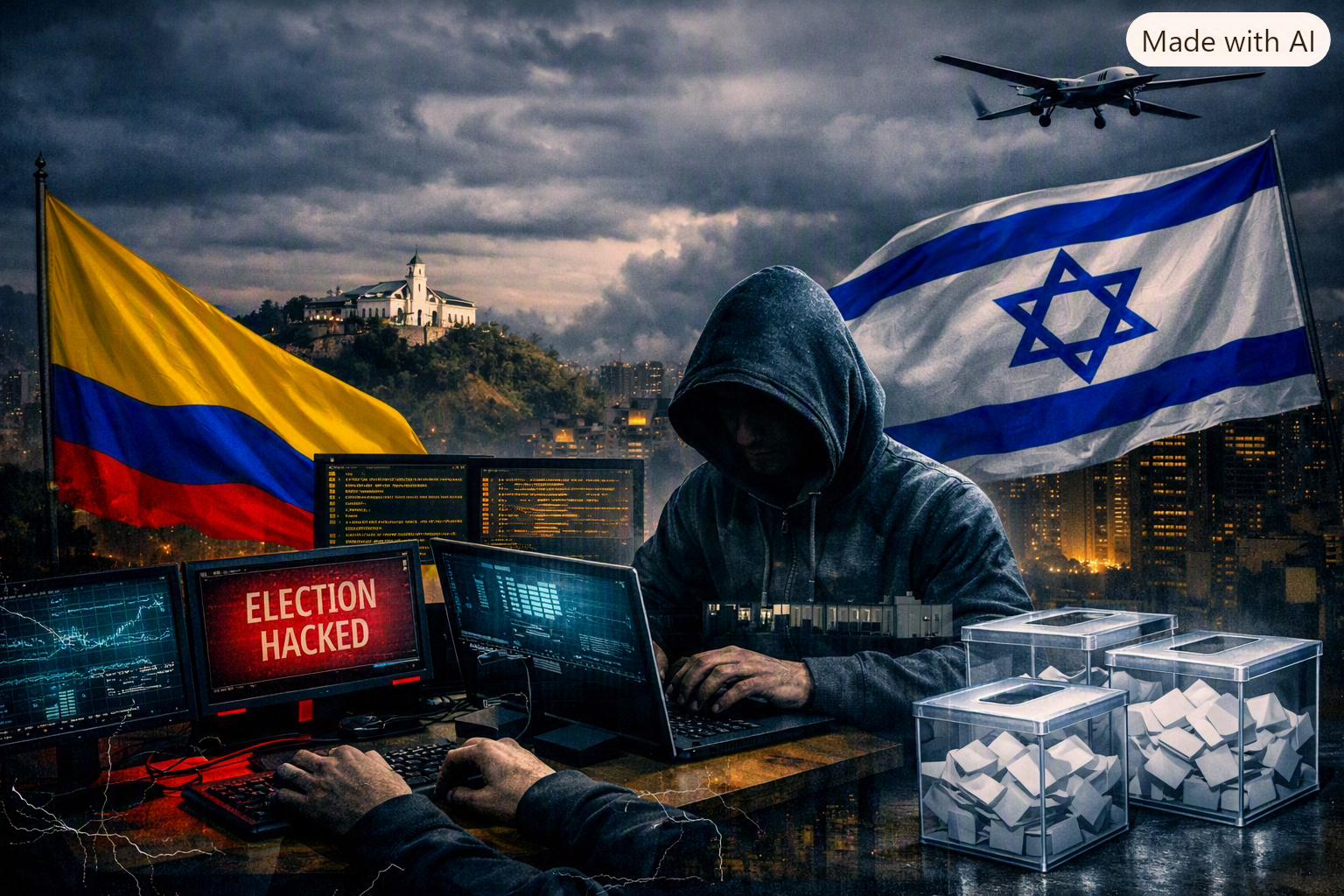
In Latin America, the Hondurasgate scandal [i] did not stop at Tegucigalpa: in Colombia, it has erupted as the most blatant case of electoral interference documented to date. A testing ground where many dirty tricks were played: digital manipulation, coordinated disinformation, falsification of voting data. All with a specific aim: to delegitimise Gustavo Petro’s progressive government as an ‘anomaly’ to be corrected (rather than as the sovereign choice of the Colombian people); to sabotage the progressive candidacy of Iván Cepeda of the Pacto Histórico; to fuel economic panic and hand the country over to the right.
The Jupiter Project and the Petroleaks platform are not ‘fake news’, but the backbone of a transnational network that intervenes before, during and after the vote.
Project Jupiter: AI as a weapon of political warfare
‘Project Jupiter’ marks a turning point: disinformation becomes industrialised. AI produces and multiplies manipulated content, toxic narratives and distorted data. This is where Grok, the chatbot from Elon Musk’s X, comes in; it has been accused of spreading false information to undermine Cepeda. The algorithm, that is supposed to inform, becomes an automatic generator of economic alarms and apocalyptic scenarios, designed to link the Pacto Histórico with instability and collapse.
The strategy is clear: to saturate the digital space with fear, to make people believe that a progressive victory is equivalent to capital flight and the collapse of the markets. Not analysis, but media terrorism.
Petroleaks: the nerve centre of the dirty war
If Jupiter is the laboratory, Petroleaks is the sounding board. Petro has exposed a network of companies allegedly funding digital operations between Colombia and the United States. In turn, the director of Colombia’s Financial Information and Analysis Unit (UIAF), Wilmar Mejía, has spoken openly of a platform managed from abroad to spread anti-government propaganda, with a web of corporate links spanning Colombia, the United States, Panama, Brazil, Spain and Italy [ii].
PetroLeaks is therefore not an isolated incident, but part of ‘Hondurasgate’. Opaque funding, simulated commercial transactions, targeted propaganda, media manipulation. An invisible infrastructure where politics is not conducted in the streets, but through algorithms.
These manoeuvres laid the groundwork well before the vote. And as the Hondurasgate’s audio recordings revealed, Donald Trump also openly backed the right-wing candidate in Colombia. Thus, the convergence of international lobbies, the local right wing and digital platforms found its common ground in the campaign against Cepeda.
The Israeli friend: Black Cube and ‘algorithmic fraud’
One of the most disturbing aspects that the Hondurasgate scandal has brought to light is the involvement of Israeli ‘private’ companies in electoral intelligence and security systems. This is not merely a matter of technical consultancy, but of ‘private’ intelligence organisations becoming directly involved in processes that should be subject to public and transparent oversight.
In the Colombian case, the most serious aspect is the allegation of direct manipulation of the electoral system, through a breach of cyber security in the recording of votes and the transmission of results. The now former President Gustavo Petro has denounced electoral fraud carried out from abroad, specifically from Israel: ‘The elections were stolen by wealthy Israelis led by a genocidal figure, and they did so from abroad by altering the voting results’. On his social media account, he spoke of “the alteration of results in more than 1,600 polling stations”, particularly in the areas of Bogotá, Antioquia and northern Santander [iii].
Against this backdrop, Petro has renewed his attack on Israel, accusing it of “algorithmic fraud”. According to his statements, “we now have evidence that the IP addresses of several servers belonging to the National Registration Office have been altered. This means that the software has been hacked and that others have entered data relating to polling stations and voting terminals. The only entity in the world capable of doing this is the State of Israel. I am calling for a thorough inspection of all polling stations and a recount of all votes, along with an analysis of breaches in the electoral software and of the polling stations where irregularities have occurred” [iv]. All these requests have fallen on deaf ears.
According to Petro, the fraud was allegedly organised and run by the United States through private intelligence firms. Among these, the former president mentioned Black Cube, an Israeli company which, according to his statements, “provided faulty algorithms and other support…” [v]. Black Cube, founded in 2010 by former Israeli intelligence officers Dan Zorella and Avi Yanus, is mainly composed of former members of the State of Israel’s intelligence and security units, including former Mossad agents, and has carried out private intelligence operations in various countries.
Trump, Netanyahu and the new geopolitics of digital electoral fraud
At the heart of this story lies not only Colombia, but new geopolitics of electoral manipulation. Petro has linked the attacks on Iván Cepeda and the ‘Hondurasgate’ operation to a wider conspiracy, involving Israeli Prime Minister Netanyahu and drug trafficking, with the aim of ‘destroying progressivism in Mexico and Colombia’.
The sequence is quite revealing: digital disinformation campaigns, platforms such as Petroleaks, operations such as Jupiter, the use of chatbots such as Grok, the involvement of ‘private’ intelligence firms such as Black Cube, and Donald Trump’s public support for the far-right candidate. It is an assembly line of political destabilisation, where each link has a specific function: to instil fear, to delegitimise, to manipulate, and finally to certify as ‘democratic’ a result that stems from a rigged system.
In this scenario, Colombia is not merely a victim, but also a reflection of a continent where elections are no longer decided solely at the ballot box, but on servers, in data centres and in digital propaganda hubs. Where sovereignty is not threatened by tanks, but by opaque algorithms, by networks of companies operating between Miami, Tel Aviv, Madrid and Bogotá, and by foreign presidents who openly intervene in favour of far-right candidates.
Colombia realigns itself with Israel
Following Gustavo Petro’s progressive interlude, Abelardo de la Espriella’s accession to the presidency marks a clear return to a foreign policy of realignment with Israel. This is no sudden change: behind this shift lies a well-oiled network of diplomats, leaders of Jewish organisations, evangelical leaders, political operatives and new government officials. An ideological and religious bloc that views political support for the State of Israel not merely as a geopolitical choice, but as a mission central to its identity.
The contrast with Petro’s stance is stark. The progressive government had severed diplomatic relations with Israel, drastically cut purchases of military aircraft, denounced the bilateral treaty, suspended coal exports and joined the case brought by South Africa against Israel before the International Court of Justice for violations of the Genocide Convention. This was a profound break, which had placed Bogotá amongst the most vocal critics of Netanyahu’s government.
With De la Espriella, the compass is once again pointing towards Tel Aviv. The new government has announced that it will reverse all the decisions of the previous administration and that it intends to deepen bilateral cooperation. This is not merely a diplomatic rapprochement: the agenda is ambitious and politically significant.
The stated priority is cooperation on security, intelligence, trade and technology. It is not merely a matter of fully reopening diplomatic and operational channels with Israel, but of once again becoming one of its key allies in Latin America. This position makes Bogotá a strategic pillar in the regional network that Netanyahu is seeking to consolidate, not least through the Isaac Agreements – the political and diplomatic platform Israel uses to expand its influence by leveraging a combination of military cooperation, technology and religious diplomacy
The Duque legacy: Bogotá hand in hand with Tel Aviv
But Colombia’s return to Israel’s sphere of influence did not begin with Abelardo de la Espriella: it is a political legacy that has its roots in the government of Iván Duque (August 2018 – August 2022), which transformed Israel into a strategic ally in the fields of innovation, security and technology transfer. During that period, one name stood out above the rest: José Manuel Restrepo, now vice-president in the De la Espriella government, who was then Minister for Trade, Industry and Tourism. It was he who signed the Free Trade Agreement (FTA) between Colombia and Israel, which came into force on 11 August 2020, presented by Duque as a ‘strategic gamble’ to make Israel a privileged partner.
The treaty was not merely a removal of tariff barriers for thousands of products: it opened avenues for cooperation in agricultural technology, cyber security, telecommunications, health, biotechnology and environmental technologies. It was a ‘modernisation’ package from which Gustavo Petro’s previous progressive government had declared its intention to withdraw, in order to render it null and void.
Today, in an ironic twist of history, many of the points that Petro wanted to scrap have returned to the centre of the agenda for De la Espriella and his vice-president Restrepo, who has just announced the opening of an office of the Colombian government’s Agency for Entrepreneurship and Innovation (iNNpulsa) in Israel. Colombia is thus back where Duque had taken it.
The magical political-religious circle that elected De la Espriella
But how is it possible that an obscure lawyer for drug traffickers and paramilitaries could magically transform himself into President of the Republic, after trailing far behind in the polls?
The new President, De la Espriella, owes a great deal to Israel and to the political-religious ‘magic circle’ that played a decisive role in his victory. Behind his victory lies not just a well-orchestrated election campaign: there is a political-religious ‘magic circle’ that worked for months to get him into the Casa de Nariño. A ‘magic circle’ comprising Israeli diplomats and officials, leaders of pro-Israeli Colombian organisations, and evangelical leaders: a network that has supported the candidate from the outset and which today directly influences the government’s decisions on security, trade, technology and foreign policy.
Even before he was elected, De la Espriella had promised to restore diplomatic relations with Israel and to make this an absolute priority. Struck by a revelation whilst on his way to Tel Aviv, both before and during the election campaign, he stepped up his meetings with senior Israeli officials and made a series of bombastic announcements: the appointment of ambassadors, the abolition of visa requirements, and Colombia’s withdrawal from South Africa’s case before the International Court of Justice (ICJ) concerning the genocide against the Palestinian people [vi]. A complete realignment, culminating in the recognition of Israeli sovereignty over the Golan Heights and the decision to open the Colombian embassy in Jerusalem, even though most states do not recognise it as Israel’s capital.
The Israeli blessing: between Netanyahu and the CCJC
Behind the scenes, the Israeli embassy in Colombia and the leaders of organisations close to the Israeli government have built a network of dialogue with the then-candidate De la Espriella and with many of the officials who now make up his government. A relationship that has now been politically cemented.
De la Espriella’s support for Israel (and vice versa) is therefore not a spur-of-the-moment decision: it is a political project built up over time and with care, the aim of which has been to strengthen ties with political and religious organisations and those close to the Israeli government. As documented by Revista RAYA[vii], as early as August 2025, De la Espriella was openly defending Netanyahu’s military operations, arguing that the Israeli Prime Minister was doing “what he had to do” to protect his people — and that he would have acted in the same way to defend Colombia, “no matter what it takes” [viii].
On 1 April 2026, De la Espriella and Restrepo met with the Confederation of Jewish Communities of Colombia (CCJC) and the Sephardic Jewish community of Bogotá [ix]. ‘You know how much this community means to me,’ said the candidate. ‘I will never hesitate to defend the Jewish people, who are our brothers and sisters, and with your help and God’s help we will save and rebuild Colombia. Long live the people of Israel!’ [x]. The standing ovation at the end did not go unnoticed in Tel Aviv: Amichai Chikli, the Israeli Minister for the Diaspora and the Fight against Anti-Semitism, shared a video of the meeting, celebrating the Colombian election result. “This signifies not only the collapse of populist socialist ideologies, but also the strengthening of Israel’s position on the continent,” he wrote on X [xi].
The Zionist lobby in Colombia
Within the network that has driven Colombia towards Israel, two names stand out prominently: Kobi Valer, Israel’s consul in Colombia, and Marcos Peckel, a professor at the Universidad del Rosario, executive director of the Confederation of Jewish Communities of Colombia (CCJC) and one of the most active voices in defence of the State of Israel. Valer became the face of the Israeli diplomatic mission following the breakdown in relations between Gustavo Petro and Benjamin Netanyahu in May 2024. Since then, he has led an intensive political lobbying campaign, becoming the Israeli government’s main point of contact in Bogotá.
Together with Peckel, in 2024 Kobi Valer organised trips for Colombian journalists, editors, commentators and influencers to Israel and the occupied Palestinian territories. This was a propaganda strategy (Hasbara) deployed during the military offensive on Gaza and documented by El Armadillo [xii].
Marcos Peckel, for his part, has been one of the most visible figures in the pro-Israeli lobby in the country for a decade. He chaired the meeting between De la Espriella and the CCJC, consolidating a relationship that had already been strengthened well before the election victory.
On 25 November 2025, whilst he was still trailing far behind in the polls, De la Espriella met with the Israeli Foreign Minister, Gideon Sa’ar. Commenting on the meeting, he wrote: ‘With the help of the United States and Israel, we can, once and for all, wipe out the world’s oldest guerrillas’ [xiii]. And without waiting for the final election results, both Netanyahu and Israeli President Isaac Herzog had congratulated him on his victory. ‘Israel’s friends continue to win. Long live the Isaac agreements!’, Netanyahu posted on X [xiv]. On 6 August, Gideon Sa’ar met De la Espriella in Barranquilla and the following day represented Israel at his inauguration.
Evangelical churches and Christian Zionism: the second pillar of the alliance
Alongside diplomacy, another actor has played a decisive role: the influential Colombian evangelical movement, which for years has been politically and religiously aligned in support of the State of Israel. At the forefront are the churches that identify with Christian Zionism or with Judeo-Christian movements. One of their main platforms is the Confederación Evangélica de Colombia (Cedecol), led by Lyda Arias de García, which brings together pastors, leaders and representatives of Christian organisations.
Cedecol maintains a direct, high-level relationship with the State of Israel. A clear indication of the level of engagement was the meeting, on 2 July 2026, between Pastor Rodrigo Barreto – vice-president of Cedecol, leader of the Christian and Missionary Alliance Church and an official of the Valle del Cauca Governorate – and the Israeli President Isaac Herzog [xv].
Cedecol also has a YouTube channel which, prior to the formal start of the presidential campaign, served as a forum for dialogue with politicians close to De la Espriella [xvi]. As documented by Revista RAYA, Cedecol also promotes religious tours to Israel in collaboration with The Land Tours, an international operator specialising in ‘biblical, historical and cultural tourism’. In Colombia, the company is represented by William Teo Sanchez Camargo, who openly supports De la Espriella.
Whilst the Zionist and pro-genocide lobby operates with impunity, recruiting politicians, influencers, journalists, secondary school and university students, Revista RAYA has come across a declassified document from the Israel Defence Forces. The document details the number of foreign nationals who have directly participated in the military operations of the genocide in Gaza: more than a hundred Colombians are reportedly involved in one of the worst crimes against humanity [xvii].
Last but not least, between the first and second rounds of the election, some of these churches organised a day of prayer, calling on people to vote against the proposals put forward by the left-wing candidate Iván Cepeda.
The Evangelical Community in De la Espriella’s Government
Before his election, De la Espriella surrounded himself with religious leaders and political figures who share a deep affinity with Israel. Today, many of them hold key posts in the new government.
His right-hand man, Carlos Alonso Lucio, a former M-19 guerrilla fighter (convicted by the Supreme Court of Justice for making a false accusation), is one of the main links between the evangelical community and the new President. His wife, Vivian Morales, a member of the church “House on the Rock”, has been appointed Minister of Education.
The President’s spokesperson and head of media relations is Carolina Gómez Sánchez, former executive director of the Colombian-Israeli Chamber of Commerce. Carolina is the daughter of Pastor Eduardo Gómez, who is currently the Commissioner for Religious Freedom in the Americas at the Organisation of American States (OAS). But the list goes on.
The new government is therefore also the result of a convergence between Israeli diplomacy, the Jewish lobby, Christian Zionism, political operatives and evangelical leaders. A network that supported De la Espriella during the campaign and which now shapes his foreign policy, security, technology and public narrative.
It is not merely a question of ideological affinity. Israel offers governments that have made ‘security’ and a ‘hard line’ their creed an irresistible package for mass surveillance: intelligence, cyber security, military technology and artificial intelligence. An arsenal that goes beyond traditional consultancy services in agriculture or water management. It is the promise of total, centralised and technologically driven security.
A democracy under algorithmic attack
The Colombian case shows that democracy can remain formally intact (polling stations, ballot boxes, ballot papers, international observers), yet be substantially sabotaged and stripped of its meaning. The ‘algorithmic fraud’ denounced by Gustavo Petro, together with Wilmar Mejía’s allegations regarding the criminal network behind PetroLeaks, are pieces of a jigsaw puzzle in which the vote is no longer merely a political act, but data to be manipulated.
The political question today is not merely who really won the elections, but who controlled the software, who devised the algorithms, who paid the digital campaigns, and who decided what content should appear on Colombians’ mobile phones on the eve of the vote. And, above all, who has an interest in turning Latin America into a permanent testing ground for electoral interference, where every progressive government automatically becomes the target of destabilisation operations.
Colombia is the best-documented case, but it is certainly not the last. If sovereignty is not also defended in the digital realm, the next ‘Patria Boba’ will be that of peoples who continue to vote, convinced they are making their own choices, whilst someone else—from afar—rewrites the results.
[ii] https://www.diario-red.com/articulo/colombia/hondurasgate-confirma-colombia-operacion-internacional-desinformacion-ivan-cepeda-p/20260621034239071679.html
[iii] https://x.com/petrogustavo/status/2068831260982571151
[iv] https://www.telesurtv.net/petro-detalles-fraude-algoritmico-presidente/
[v] https://mpr21.info/el-presidente-colombiano-acusa-a-israel-de-manipular-las-elecciones-presidenciales-en-su-pais/
[vi] https://www.cancilleria.gov.co/sala-de-prensa/noticias/colombia-intervendra-ante-la-corte-de-la-haya-en-el-caso-de-sudafrica-contra-israel
[vii] https://revistaraya.com/migdalia-arcila-valenzuela/1713-la-promesa-de-un-genocidio.html
[viii] https://www.revistaraya.com/el-circulo-politico-religioso-detras-de-la-alianza-entre-de-la-espriella-e-israel.html
[ix] https://x.com/MossadAgente7/status/2069042981517086846?s=63
[x] https://x.com/ABDELAESPRIELLA/status/2039389034523324583?ref_src=twsrc%5Etfw%7Ctwcamp%5Etweetembed%7Ctwterm%5E2039389034523324583%7Ctwgr%5Ef24cb1ae717a17ca27b5fc3459f9222dc3b1f809%7Ctwcon%5Es1_&ref_url=https%3A%2F%2Fwww.lasillavacia.com%2Fen-vivo%2Fante-grupo-judio-abelardo-reitera-traslado-de-embajada-a-jerusalen%2F
[xi] https://x.com/AmichaiChikli/status/2068944258241855642
[xii] https://elarmadillo.co/la-madriguera/periodismo-todo-incluido-desde-el-lado-israeli-de-la-guerra/
[xiii] https://x.com/ABDELAESPRIELLA/status/2010871180002279687
[xiv] https://x.com/IsraeliPM/status/2069019031718261124
[xv] https://www.instagram.com/p/DaTFdb0u6mj/
[xvi] https://www.youtube.com/watch?v=L2HZqadKwQQ.
[xvii] https://revistaraya.com/exclusivo-112-colombianos-han-participado-del-genocidio-en-gaza.html