by Marco Consolo –
In the first part of this article, I described the dangerous relations between Israel and the civil-military dictatorships of Latin America in the 1970s and beyond. Much has changed since then, but far from disappearing, the Israeli presence has diversified and added new strings to its bow.
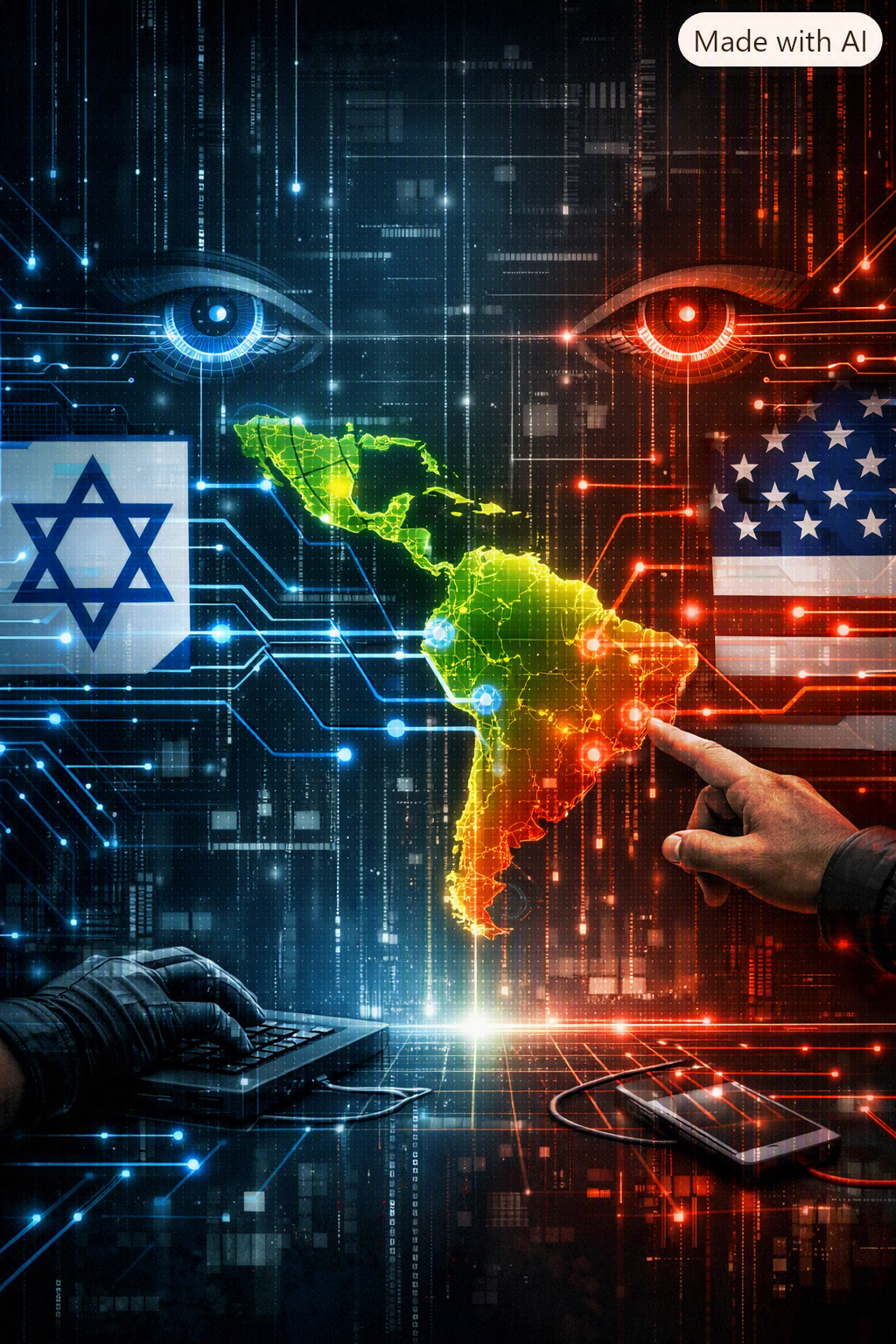
This second part explores some general aspects of the ‘new’ digital coups d’état and the manipulation of public opinion, used to reshape the continent’s political landscape.
The next article will focus on specific cases in several countries.
Military strategy and control of algorithms
An international operation to exert control and reshape the geopolitical landscape, spearheaded by the United States and Israel, has been underway for some time across various countries in Latin America and the Caribbean. This is a systematic political, economic, military and digital strategy that continues to develop and is gradually intensifying in the region.
In this geopolitical reconfiguration of the continent, ‘security’ is one of the main tools used by the United States and Israel to control energy, biodiversity, water, critical minerals, logistics corridors and global supply chains. This objective has accelerated the outsourcing of state functions to private surveillance, security and intelligence firms. Through ‘technological modernisation’, domination is consolidated, whilst war, espionage and social control become commodities to be traded.
For some time now, Israel’s presence has no longer been limited to the sale of arms. In recent years, it has expanded to include the use of big data for electoral manipulation or ‘digital coups d’état’, the development and marketing of spyware, intelligence systems and operations, tools for mass digital surveillance, and algorithmic analysis platforms used by both governments and private actors.
Audio recordings released by the Hondurasgate.ch [i] platform and published by Canal Red Latin America have highlighted the growing role of Israeli companies specialising in private intelligence, cyber security and technological surveillance. This is a relatively recent element in the imperialist offensive against progressive and left-wing governments in Latin America and the Caribbean. This offensive has intensified and is no longer confined to the military sphere; rather, it is characterised by ‘Fourth Generation Warfare’ (4GW) [ii]. A hybrid war which, in addition to traditional economic blackmail, financial operations and the more recent use of ‘lawfare’ (judicial warfare), is making a forceful entry into the region’s political and electoral processes through ‘soft coups’, thanks to the unscrupulous use of Big Data, massive media and cultural operations.
In this war, Israel is at the forefront of state and private intelligence services working on behalf of the United States, carrying out digital manipulation operations, coordinated disinformation campaigns, cyber espionage and the tampering of election results.
Digital coups d’état
The digital warfront is particularly decisive, both in terms of manipulating public opinion and falsifying electoral data, and it brings to light the new paradigm of hybrid warfare involving political interference.
But let us take things in order.
In the first instance, one of the main tools of G4G is cognitive dissociation, aimed at undermining the notion of identity that underpins national and popular sovereignty. As early as 2015, in Argentina, there had been the precedent of Steve Bannon and his Cambridge Analytica, hired by the local right-wing to run Mauricio Macri’s successful election campaign.
As Jorge Elbaum writes, “Three tools now concentrate the power to interfere in elections: deepfakes, micro-segmentation and standardised algorithmic biases. The first enable the creation of plausible images, videos or audio clips, albeit artificially generated. Micro-segmentation identifies the predispositions, fears and vulnerabilities of specific groups of voters in order to target them with tailored messages: for example, convincing pet owners that progressives intend to impose taxes on dogs and cats. Algorithmic biases, in turn, enable large multinationals to tailor recommendations and content according to their own economic and neo-colonial interests.” [iii].
The imperial counter-offensive
There is a clear sequence to the final steps of the imperial strategy aimed at totally or partially nullifying the sovereignty of others and subjugating enemies, competitors and opponents – but also allies -, who are transformed into targets for subjugation and control.
In March, the ‘Shield of the Americas’ [iv] was launched, strongly championed by the hawkish Marco Rubio, Secretary of State and Trump’s proconsul for the region.
From 7 to 10 July, the 17th meeting of Defence Ministers from across the Western Hemisphere was held in Cusco (Peru), convened as always by the US State Department and US Southern Command, rather than by Latin American governments. The Cusco Declaration sets out the main agreements on ‘the fight against drugs, migration and crime’ [v].
As Assistant Secretary of State Albridge Colby said, much has changed since the first meeting in 1995. “We have come to assume the role of guardians of the Monroe Doctrine… which consists of protecting our security and our interests by strengthening and empowering Latin American nations.”.
As the Peruvian analyst Ricardo Soberón argues, “Today we are facing the ‘War on Drugs 2.0’, which merely repeats the mistakes of its predecessor (more stick and less carrot, glyphosate fumigation, interdiction and extradition)” [vi]. A misguided war that has yielded no results.
Soberón continues, “The summit was shaped by the line set out by Marco Rubio, starting with his new National Security Doctrine (2025) and National Defence Doctrine (2026). Colby advocated a flexible realism that prioritises the national interests of the United States. In this context, the fight against ‘transnational organised crime’ will take place in Latin America, certainly not on US soil. It is no coincidence that, according to Marco Rubio and Donald Trump himself, the concept of transnational organised crime is directly associated with progressive or left-wing governments that do not align with US imperial policy. In recent months, there has been a flurry of attacks against Nicolás Maduro, Evo Morales, Rafael Correa, Gustavo Petro and even the President of Mexico, Claudia Schembaun” [vii].
Today, following in the wake of Casabianca’s frenzied attacks on any progressive organisation in the US (Antifa, migrant organisations, progressive churches, feminists, etc.), the ambiguous concept of ‘drug-related terrorism’ is re-emerging in the south of the continent. This definition lumps together very different social groups, including those engaged in legitimate protest (trade unions, environmental movements, coca growers’ organisations, indigenous peoples, etc.).
As you may recall, it was precisely at the notorious US Armed Forces’ School of the Americas in the 1970s that the National Security Doctrine was coined and drummed into Latin American military personnel. A doctrine that created the spectre and the figure of the ‘internal enemy’, then attributed to ‘communists and revolutionaries’ and now to ‘transnational organised crime’.
On 10 July, a meeting took place in Miami (attended by more than 60 governments). A call to arms to the allies, serving as a vivid illustration of imperial domination.
The aim is precisely to fabricate ‘internal enemies’ that would justify interventions against progressive governments and to consolidate a structure of permanent domination over Latin America, by establishing an automatic association between left-wing governments and criminality. This is a corollary of the ‘Donnroe Doctrine’ set out by Donald Trump at the end of 2025.
Most recently, on 11 August in Panama, this was followed by the announcement of the creation of a ‘task force against organised crime’ under the umbrella of the ‘Shield of the Americas’, with 18 countries joining the initiative [viii].
The “operational arm of Southern Command” will be led by US Marine Corps Major General Kevin Jarard. Officially, it will be responsible for the exchange of intelligence, for strengthening joint training and the interoperability of the participating military forces, and, at the same time, for supporting maritime interdiction operations.
As a first step, the US Secretary of War, Pete Hegseth, has announced joint military operations with the Colombian armed forces against “the narcos”, which the new Colombian president had authorised in defiance of the Colombian Constitution (Article 173), which grants the Senate exclusive authorisation in this regard.
But it would be a mistake to think that the United States is acting alone. On the contrary, Israel plays a key role in this counter-offensive.
The ‘Epstein coalition’, ‘Hondurasgate’ and the foretold interference
Let’s take a step back. It is worth recalling that on 29 December 2025, President Trump met with Israeli Prime Minister Netanyahu in Palm Beach, Florida. Under the Christmas tree, the ‘Epstein coalition’ summit was the fifth to be held in the United States last year.
A few months later, thanks to wiretaps of conversations between members of the Honduran right, the so-called ‘Hondurasgate’ scandal erupted – one of the biggest documented scandals involving US and Israeli political interference in Latin America in the 21st century.
The first target was Honduras’s ‘weak link’, first through the manipulation of key electoral segments, then directly through the falsification of election results. All this was done to pave the way for a victory by right-wing forces serving US and Israeli interests.
As you may recall, a few days before the elections in Honduras, Donald Trump had pardoned the former Honduran president, Juan Orlando Hernández, from his 45-year prison sentence for drug trafficking, for having smuggled 450 tonnes of cocaine into the United States. In wiretapped conversations, Hernández revealed the pressure exerted on his behalf by the US Zionist lobby, as well as Netanyahu’s own intervention to secure his release, in exchange for his role as an agent working on behalf of the United States and Israel. As part of the deal to secure the judicial pardon, in addition to the construction of new US military bases in the region, the green light was also given for the arrival of companies specialising in artificial intelligence and ‘surveillance technologies’ linked to the Israeli secret services.
In one of these conversations, Hernández asks for funds to set up a ‘digital journalism unit’ based in the United States, with the aim of spreading fake news against left-wing governments in Latin America (particularly Colombia, Mexico and Brazil) and against former Honduran presidents Manuel Zelaya and Xiomara Castro. Hernández also claims that Argentine President Javier Milei has already contributed $350,000. That ‘journalistic’ unit, dedicated to cognitive warfare and amplified by AI infrastructure, ‘social media’ and traditional media propaganda, quickly moved from words to deeds, to secure a ‘victory’ for the most reactionary right-wing forces, thanks to the manipulation of public opinion and electoral fraud.
In less than three months, Honduras, Colombia and Mexico have faced smear campaigns in the traditional media, disinformation operations, hacking on ‘social media’ and cyber-attacks that have also targeted the systems used to count and transmit electoral data.
The actions described in the audio recordings coincide with the public allegations made by Colombian President Gustavo Petro, Mexican President Claudia Sheinbaum and former Honduran President Manuel Zelaya. All three have denounced various incidents of interference, disinformation campaigns and attacks on the digital and political infrastructure of their respective countries.
In the case of Honduras, there were first the blatant electoral frauds (including digital ones) in the recent presidential elections of November 2025 [ix].
Subsequently, on 17 July, former President Manuel “Mel” Zelaya claimed via his X account that former President Xiomara Castro’s mobile phone had been hacked, allowing unauthorised access to her “social media accounts”. All previous posts were deleted from the account, and three posts were published, which were subsequently deleted.
The first was a video of Israeli Prime Minister Benjamin Netanyahu with the message: “Netanyahu is a lovely chap”. The second suggested an alleged betrayal by Xiomara Castro against her husband, Mel Zelaya, during the 2009 coup. The third manoeuvre sought to link the Zelaya family to drug trafficking by publishing a video from 2017, accompanied by manipulated audio. This is precisely one of the strategies described in ‘Hondurasgate’, involving the dissemination of alleged ‘files’ against the Zelaya family to undermine their political credibility and erode their public image.
To be continued……
[ii] As early as 1989, the ultra-conservative William S. Lind (and sections of the Pentagon) began to develop the G4G doctrine, which was refined in the years that followed.
[iii] https://www.pagina12.com.ar/2026/07/04/operaciones-regionales-de-injerencia-electoral/
[iv] https://marcoconsolo.altervista.org/note-sullamerica-latina/
[v]https://www.gob.pe/institucion/mindef/noticias/1417452-ministros-de-defensa-y-representantes-de-33-paises-suscriben-declaracion-de-cusco-para-fortalecer-la-cooperacion-hemisferica
[vi] https://nuevordeninternacional.com/reunion-de-ministros-de-defensa-en-el-cusco-nos-necesitan-a-nosotros-o-nuestros-recursos/
[vii] Ibidem
[viii] https://www.latercera.com/mundo/noticia/con-chile-entre-sus-miembros-eeuu-crea-fuerza-operativa-con-18-paises-de-america-para-combatir-el-crimen-organizado/
[ix] https://marcoconsolo.altervista.org/honduras-un-golpe-sotto-lalbero-di-natale